Future of computing
Demand creates invention -- Hunter Lloyd
What I mean by that is if something is needed in today's society somebody
will invent it.
The future is a funny thing. We pretend we know all about it and
yet it continues to fool us every chance it gets. As I wrote this
lecture I looked back on some of the notes I used just two or three years
ago. Many of the wild predictions I made back then fell flat on my
face. But, thankfully, some of them are coming true.
I like this lecture the most because it gives us a chance to look into
the future of our lives. Lots of times, as we go about our busy lives,
we don't notice subtle changes in our environment. Suddenly, that
old dilapidated building that you used to pass by on your way to work is
gone. You wonder to yourself when it fell down. Was it
yesterday or a week ago. Things happen so fast sometimes, yet take
years.
Some of the information in this lecture is all speculation. Some
of it is happening right under our noses, and parts of it is somebody's
pipe dream. You decide which is which. Whatever way you choose
to look at it though, many of the changes will affect the very essence
of your life. How do you feel about cybercash? Are you in favor of
WebTV and NetPCs? How do you think the software revolution will affect
you?
Background
The computer revolution and evolution has been marked by industry kings
throughout its different periods. IBM was king in the 60s with mainframes
but they've slid down the totem pole in the PC game. Digital Corporation
and a few others took over with the minicomputer in the 70s. Digital who?
As we're all familiar with, Microsoft was king in the 80s with PCs and
the software revolution. And Intel Corporation has dominated the hardware
side. The question now is "Who will be the king of the 90s." Interestingly
no one company has really emerged in this decade as the absolute leader.
To be sure, Microsoft has continued its "leader" status. But others, mainly
companies involved in Internet products, have been slowly chipping away
at their stranglehold.
"We're in a business where no amount of success guarantees future success"
-Gates
ASIMO
 | Before we get into too many details I will
start with
a
concept we've
all seen on the Movies that has now become a reality.
Honda has created a robot that is almost human. For one small example it
can open the door to your house and if the person at the door has been
seen by the robot before the robot will recognize the person. Greet the
person by name. So if you were nervous about meeting your
boyfriend/girlfriends dad, just think what it will feel like to meet their
robot. |
Here is a link to Honda's Web page on ASIMO
|
Software Revolution
Computers will function as multimedia communications devices
instead of glorified calculators and typewriters - Business Week - 1995
And of course today in 2002, besides calculating and typing, computers
main function is multimedia.
Software today -
For the last fifteen years or so you've been locked into the "Wintel"
standard
of personal computing. That is Windows software
and Intel microprocessing chips. Microsoft
Corporation controls about 85-90% of the market for word processing, spreadsheet,
and database software. They also have their operating system installed
on 95 % of the personal computers (IBM compatibles) sold in the world.
But they only have about 40-50% of the Internet software market.
Until 1997 Intel Corporation controled approximately 87 % of the market
for microprocessing chips. In the last few years, AMD and Cyrix
have been slowly "chipping" (pun intended) away at Intel's market dominance
with cheaper and just -as-good microprocessor chips. Now Intel's
market dominance has been reduced to around 50%. A significant slide
if you ask me! Many of the other companies involved in personal computing
would love to break the rest of the Wintel chokehold. Hence, this is part
of the reason the Microsoft Anti-Trust suits started being fought in 1999, and
are still being fought today.
Nowadays, you have to purchase "bloatware," huge software programs
of which you'll probably only use about 20% of the features. Nevertheless,
you have to purchase and install the entire software program.
Software in the future
There's a newer, better, faster, cheaper, and easier way emerging to
resolve and reduce the hassle of obtaining software. The Internet! You
can now jump on the Internet, go to the Web site of the software producer,
make a few clicks, and within minutes the software is downloaded and installed
on your computer. Many of you did just that at the beginning of the
semester when you downloaded and installed Eudora Lite Email software.
If the software manufacturer finds a bug in the software, they put a fix
on their Web site and within a short time you have access to the coding
to fix your problem. No more waiting, and waiting, and waiting. I
did just that a few weeks ago with Netscape Navigator.
The software companies can save you lots of money because they don't
have to put the programs in fancy packages, ship it out, beg the retailers
to put it on their shelves, and pay all the extra costs of the old way
of doing business. Many software manufacturers are now bypassing the old
"food chain" altogether and only putting their software on the Internet.
The savings are passed on to the customer with cheaper prices.
Obtaining software is becoming more like buying magazines or books.
Think about how you buy magazines now. You may subscribe to a magazine,
in which case you get it delivered right to your home, on a regularly scheduled
basis - weekly or monthly. You enjoy the continuity of the
articles and/or a particular columnist. Sometimes though you
see a single issue of a magazine in the bookstore or grocery.
You see an article headline on the front cover that entices you to buy
that single issue. You don't want a long term subscription - just
that one issue. So you buy just that one issue, read the article,
throw the magazine away, and you're happy.
The evolution taking place in the software industry is similar to that
of magazines. Take out a subscription for a software package
and you'll get the entire initial program and any updates that may come
out in the future on a regular schedule. This particular program
happens to be one that you use a lot and want to stay on top of any upgrades
or code fixes.
You could also buy a program on a one time basis, use it for whatever
you want, and then discard it. No more bloatware. Buy only those parts
that you need and forget the rest. Saves lots of disk space!
Many excellent software programs are virtually locked out of the marketplace
because the producers can't afford the initial costs of producing thousands
of copies, packaging, shipping, and advertising. With the Internet
much of those costs are overcome. The producers don't need
to have all the fancy packaging, fight for shelf space which is usually
dominated by one or two companies (guess who that might be!), pay for shipping,
etc. They can advertise with the best of them, include a Web site
URL, and if you want the software you merely go to the Web site and download
the program.
This scenario is just beginning to take hold in the industry and is
due in large part to being able to download software and upgrades across
the Internet.
Also, the Internet's communication standards make it possible for tens
of millions of people using different operating systems and applications
to talk to each other regardless of hardware, software, or operating systems.
Now, what about the Wintel barrier?
With minimal barriers to entry, the Internet offers a software
world where no one has seized control and where entrepreneurs can reach
out to new customers without going through Microsoft or any other aspiring
gatekeeper.
A great site to download free and trial software is:
Downloads.com
There are three types of software that can be downloaded for free:
-
Freeware - Free software that can be used for no charge.
-
Shareware - Software that can be used for until the trial period expires,
or the software is only a subset of the actual progam (only 3 holes of
a golf game). Shareware is used so users can try the software for free
before they purchase the software.
-
Beta Software - A pre-release software trial. Software creators will give
free versions of their software before the actual release of the software
so users can test out the product and find any bugs the software might
need fixed.
JAVA
Your future also involves the Java programming language created a few
years ago by Sun Microsystems Inc. Java is an object oriented programming
tool. That is, you use groups of generic coding assembled together to carry
out a specific tasks. Some of the key attributes of Java and what makes
it an exciting venture are that it's designed specifically for using on
the Internet. It's hardware independent - no more unique programs for each
type of computer. No more concerns about whether you're using a PC, a MAC,
or what kind of operating system you have. Want a program? If it's written
in Java then just go get it.
Java is also "Applet" based. If all you want to do is a few
simple calculations to figure out a car loan then just download that applet and
forget the rest. Applets are Java programs that are embedded in Web pages. In
order for you to run a Java Applet you just have to have a browser that
interprets Applets. The only browsers made in the last three years that I have
found that have trouble running applets are on Apple computers, but they have
fixed it lately.
Overall, Java is a new programming language that is hardware independent,
designed specifically for networked computers, and can help make computing
interactive.
For a sample of Java go to http://java.sun.com
Java isn't just for computers either. According to Business Week
magazine, July 27, 98, here are some other uses being developed:
-
Alcatel's Internet screenphone uses Java to deliver services such as home
banking
-
Sony will use Java to link digital audio-video products, TVs, and computers
-
GM may use Java to link car systems such as navigation, climate control,
and remote diagnostics.
-
Visa International has made Java the chief way to program services such
as airline ticket purchases into smart cards
-
Dalla Semiconductor sells Java based rings, key chains, and other devices
used for access control and credit card transactions
Internet connections
The telephone lines used to transmit much of the data between networked
computers simply wasn't built for that purpose. The telephone network
that we have was built to carry voices not pictures or videos. Special
types of equipment from modems to data switches have been invented over
the years to accommodate data transmissions on the telephone lines.
The lines are simply getting maxed out. That is why we have many new
technologies for Internet connections. Most of these technologies we will go
over in the Network lectures, but here is an overview of some:.
Bandwidth is the amount of data a transmission medium (like a
phone line) can carry. Today Bandwidth is the number one problem with the
Internet. Most experts say Bandwidth problems will be solved in the next
year somehow.
WebTV
WebTV® gets you connected. Send email to friends and family, surf
the Internet, and interact with new forms of entertainment—all from your
TV. It's basically a "set-top" box similar to a cable box you attach
to your TV. It doesn't have the capacity to store very much information
or be used in ways that a typical computer is used. You can purchase add-ons
such as a keyboard, printer, or additional memory if you'd like.
Bill Gates is interested in this device. So interested he bought the
company in 1997. He has BIG plans for your television viewing! With
the cost of PC's going down since 1997 the WebTv has dropped in popularity.
Digital Subscriber Lines
Fast connections that are dedicated for Internet service. They use your
normal phone line and make it a broadband connection. To picture the advatange
of a broadband connection picture a paper cup full of water. Poke a hole
in the bottom with a pencil, the water starts to flow out, that would be
like your normal phone connection. Now poke ten to twenty holes in the
bottom of the cup, the water will start flowing out of all the holes, that
would be like your broadband connection. the data is divided over several
channels (or holes) and then sent all at once.
Satelite
The satelite will cost $399, + mandatory professional installation for
$199. The monthly fee will be $69.99. Very expensive, but it is fa st.
Line of site
Radio frequencies, Cost in Bozeman is about $200 for the equipment and $50 a
month for the service. GlobalNet provides the service in Bozeman, but I haven't
heard real good news about their service. It is good for people that live too
far for DSL, but still have line of site on their towers.
FUTURE OF HARDWARE
Just as the software industry is undergoing vast changes, so too is the
hardware.
Internet 2 (I2)Another effort is underway between universities, the government,
and industry that is less ambitious than NGI but nonetheless as enticing.
The specific goal of I2 is to advanced the use of multimedia Internet services.
Montana State is a I2 site now. We have a direct connection that links
MSU with the Backbone in Denver. If you ask for a request from another
I2 site your request goes through Denver instead of Spokane like normal
Internet traffic usually flows.
I would like to now state where I think computers will be going in the
next couple of years. There are some test questions in this part, so hopefully
you read down this far.
Computers will control the home
-
Security
-
Temperature
-
Televisions
-
Stereos
-
Lighting
-
Smart Appliances
-
Sprinklers
-
Ect. Ect.
Some day real soon your computer will answer your phone. I have an answering
machine on my computer with caller ID, but this is different. You will
be able to call your computer to turn on your oven, or dryer. Your computer
will control your smart appliances and everything else in your home.
A smart appliance will be able to communicate with your computer through
a network that links your whole house. This opens a lot of possibilities,
say your milk is almost gone, if your refrigerator can sense this, then
it can flag your computer and the computer will add milk to your grocery
list, or better yet contact the server at the grocery store and order the
milk for you.
With smart appliances you can call your computer from work and have
your computer turn on your oven thirty minutes before going home so your
food is ready when you get home. Many people ask me why I'm not married,
I say I'm waiting for smart appliances instead.
Another way PC's are going to become a bigger factor in the future is
Telecommuting
Is a work arrangement in which employees work away from
a company's standard workplace but communicate with the office using computers
and communications technology.
Studies have shown Telecommuting:
-
Increases productivity
-
Improves retention and recruiting
-
Conserves energy
-
Reduces air pollution
-
Lowers corporate real estate costs
15 million people telecommute today and it's expected to double by the
year 2010.
Education
Ten years from now college may not be at a specific time or place. All
classes might be taught just like this one. I read an article from Febuary
1999 that said "Someday classes might be taught over the Internet". I'm
a trend setter, on the edge of discovery, if I had a tattoo I'd probably
be on MTV.
The library is probably going to be impacted the greatest by computers.
Many books and documents will be turned into digital form. Eventually it
might turn into one universal library for all educational facilities. I
don't like this idea, when I was an undergrad the library is where I went
to meet girls.
They have already come out with text book readers. You buy one reader
about the size of a paperback and then your textbooks come in a disk format.
The disk fits in the back of the reader and then pages show up on the screen
which is the front of the reader. You can highlight, print, and do just
about anything you do with the textbooks you have now except use it for
toilet paper. On that note I'm done.
E-COMMERCE
The world of electronic commerce is upon us. More commonly called e-commerce,
buying, selling, over the Internet, is a new economic order. Even the word
retail is evolving to etail. All companies worldwide are going to
need to go to the Internet to survive. Local specialty stores aren't quite
as unique because of the Internet.
The E-Corporation are becoming more and more frequent. A E-Corporation
don't have a real store front, there only store front is their Internet
site. 5% of people used the Internet every day in 1995, Today 35% use the
Internet everyday and that number is expected to go up much higher over
the next two years.
The advantages of E-Commerce to the consumer are so outstanding
that it is just a matter of time until many make the switch. The merchandise
comes to you, it is much easier to find out information on a product before
you buy, hunting for a bargain is much easier and faster, and there is
no geographical boundaries. For all these reasons E-commerce is becoming
more and more popular. Competition brings the prices down for the consumer,
but the overhead of a E-Corporation is much lower so it's easier for E-corps
to compete.
PDA's PDA (Personal Digital Assistants)
are the Palm Pilots and hand-held computers.
-
The phone, the calculator, the PDA, the camera, the tape recorder, the
walkman, ... all might develop into one little machine, a true personal
assistant.
-
What come's after Window's and Mice?
The World?
WebTablets
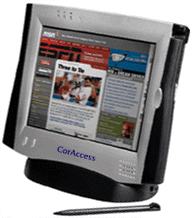
There are several companies making these now they are small computers like
the one above that have wireless Internet capabilities, you can set up a base
station in your house and this little creature can go around your house and
communicate with the base station through a wireless connection.
802.11
Wireless communication standard, this is how many of the new technologies are
going to communicate. I think this technology will shape the world five years
from now. You can have all the appliances communicate with radio waves in your
home, no wires, no configuration by people, just automatic communication. For
example, my latest 802.11 invention: Let's say the power goes out in your home,
all your clocks are blinking, if they had 802.11 capabilities when your power
comes back on your computer would just send the current time out by radio waves
and all your clocks would automatically set themselves. This is one of about ten
home ideas that I have come up with in the last year.
Biomimetics
- Definitionand short
interview
- Copying nature
- Two example I will give in class are Conch shells, extremely strong,
so scientist are trying to copy their structure.
- Nanoscale electronics is copying brittlestars, a cousin of the
starfish.
Quantum Computing
- Using quantum particles instead of transistors in computing.
- First computers are expected in 2020
- Not good for traditional computing such as Doom or photoshop, but they
are very good at figuring out massive mathematical problems such as
breaking cryptographic keys. These people are wicked smart.
- NEC in Japan is a leading rese
Mass storage
- Predictions: Terabyte capacity computers will cost less than $300
in the next five years.
- This means that you can store every ounce of data that you come across
in your lifetime on computer storage devices.
- Every phone conversation, every reciept, every greeting card,
everything.
- It will all be referenced using SQL (Standard Query Language) which is
a language for databases. It will be running on an SQL server.
- You will be able to look up Valentine and every reference to valentine
in your life will be searchable by date, size, file type, etc.
- You will never forget a joke again.
- Bell labs is a leading researcher in this field.