Programming Assignment 3: Network Layer SDN Forwarding Simulation
Assigned Friday October 28th
Due Monday November 14th @11:59 PM
GitHub Repo
You will use the same GitHub repo from PA1, and PA2. All of your files for this assignment should go inside a /PA3 folder
Overview
In this assignment, you will simulate a network of routers that use SDN-based routing for their routing decisions. Routers will do actions (forward, drop, modify) packets based on a set of rules managed by a SDN. For this assignment you will be simulating a network with 4 routers. Each router has a list of machine IP addresses that are directly connected to it, a set of links to other routers, and a set of rules defined by a SDN.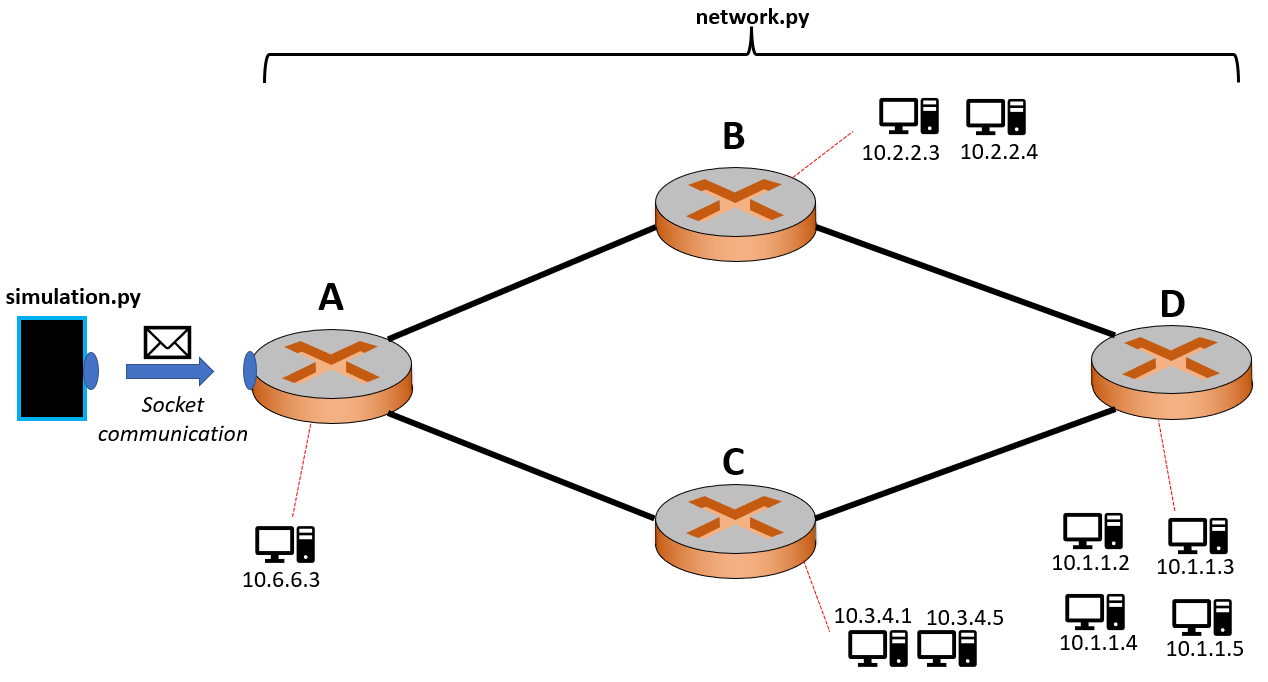
For example, Router B has two links (Link to A, and Link to B) and has the subnet 10.2.2.0/24 connected to it. Packets that arrive to router B that have an destination IP address for one those two machines can be directly delivered.
Packets
You will need to implement a packet class similarly to PA2. Each packet that gets sent into this network will have (AT LEAST) the following information: Class Packet {}- int src_ip_address
- int dst_ip_address
- int src_tl_port
- int dst_tl_port
- protocol }
Routing Rules
You will read in a set of routing rules (actions) from an external csv file. There are three possible actions:- Forward: this action will forward a packet to another router based on some condition
- Drop: this action will drop a packet based on some condition
- Modify: this action will modify the fields of the packet, and then retransmit it through the current router.
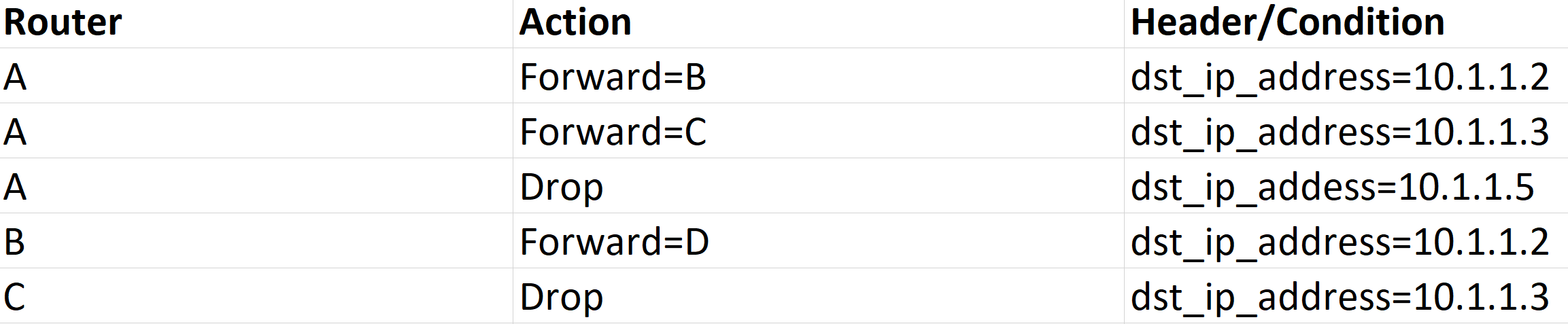
Router A gets 3 rules. If router A ever receives a packet that has a destination IP address of 10.1.1.2, it will always forward it to Router B. If a packet ever arrives with a destination IP address of 10.1.1.3, it will always forward it to router C. If router A gets a packet with a destination IP address of 10.1.1.5, it will drop the packet and move onto the next packet in the queue.
From that small snippet of rules defined above, consider a packet arrives to Router A that has a destination IP address of 10.1.1.3. Router A will check its rules, and see that it needs to forward it to Router C. The packet then arrives at router C, and router C will check its rules. Router C has a rule to drop all packets that have a dst_ip_address of 10.1.1.3, so the packet will be dropped bt router C.
Router Subroutine.
Whenever a packet arrives to router, that same procedure is usually followed.Network setup
You will also need to define a Router class. Class Router {}- list list_of_ip_addresses
- list connections
- dict rules }
You will read in this information in from a file (routers.txt)

Programs
You will develope two files. The first is network.py which will have the logic for receiving the packet, and then sending the packet throughout the network. This is where you will implement all your parsing and rule checking. The second file you need is simulation.py, and its only purpose is to send packets (via sockets) to network.py.You will send several packets, and the packets information will be read in from a text file (packets.txt)
 You will run these programs via the command line, and pass in the host information as command line arguments. The format will be
You will have to create a Packet object for each row in this file.
Programming Language
You are allowed to use a programming language of your choice. Although, you must use a language that supports:- Socket communication
- OOP or Structs
- Invocation from the command line/terminal
Input Files
Sample output
Click here to see an expected output of your program. You program output does not have to match that exactly, but your program should print out the trace of the actions taken at each router.Assumptions
- You don't have to worry about rules that would create an infinite loop
- There won't be any conflicting rules (ie a router wont have to forward AND drop the same packet.)
Hints
- Do not tackle the whole problem in one go. Take it one step at a time.
- Dont submit code that doesnt work. If you can't get packet forwarding working properly, try to get everything else working.
Video Demo
You will record a video demo that highlights the functionality of your program. You can do this with Panopto, or you can record with another recording software (such as OBS) and post it to youtube as private or unlisted. Your video demo must also provide us a brief walkthrough of your code. This means your video demo will require commentary. Especially if you are using a language other than Python/Java, it will help Reese/Justin see that you followed the instructions.Partners
You are allowed to work with 1 (one) partner. If you work with a partner, you should only create one private repository.Submission Info
NEW: BOTH MEMBERS MUST SUBMIT A REPO LINK TO D2L. All files should be pushed to your repository. You still need a README that contains the video link and information about your program.Grading Rubric (100 Points)
| Requirement | Points |
|---|---|
| Your program reads in input from three files: router.csv rules.csv and packets.csv | 10 |
| You have a packet class/struct that contains information about the protocol, src/dst ports and src/dst ip addresses | 5 |
| You have a router class/struct that contains information about the router number, ip addresses, and links | 5 |
| Your simulation program sends packets to the network program via sockets | 10 |
| Your network program can forward packets correctly | 20 |
| Your network program can drop packets correctly | 20 |
| Your network program can modify packets correctly | 20 |
| Your solution exists in your GitHub repo that has a README.md describing how to run your program. | 10 |
Penalties
- Running code results in errors before runtime: -30 points
- Running code results in errors during runtime: -15 points
- No video demo: -50 points
- Your repository is public: -100 points
Helpful Examples
- socket_objects_server.py
- socket_objects_client.py
- reverse_server.py
- reverse_client.py
- countdown_server.py
- countdown_client.py
- Sockets documentation
Solution