CS 223 Out-Labs
Mike's Outlab 2 Submission
Instructions
E-mail your completed assignment to mthiesen@gmail.com. Attach all of your
source code (.java files), a sample run (should be a .txt file), and your report
to your e-mail. Do not send any .class files. Do not zip up or archive the
files. Please use Microsoft Word for your reports. If you can't use MS Word,
print out your report and bring it with you to your lab. I have no way to view
Word Perfect files or MS Works files, so you must print them out and give them
to me in person if you want them graded!
IMPORTANT: Your subject line should follow the
following format:
CS223-xx outlab2 Name
Where
xx is your section number and Name is your name. This lets me use
filters to keep my inbox manageable. The 8am-10am lab is section 02 and the
10am-noon lab is section 03.
Example of a correct subject
line:
CS223-02 outlab2 John Doe
Questions
If you have any questions, feel free to e-mail
me at mthiesen@gmail.com. Please put the
word "Question" (without quotes) in the subject line somewhere. This will allow
my filter to pick up the question and ensure it doesn't get lost in the flood of
e-mail I get each week. Also, my consulting hours are on Wednesdays from
10am-noon in EPS110 if you need to see me personally for
help.

Out-Lab 1: Implement a Thesaurus using Hashing
Due: in one week (September 16, 2004) at the beginning of lab.
Description
A thesaurus is a dictionary of synonyms. For example, here is a small thesaurus,
with each word followed by its synonym(s):
close near confined
confined cramped
correct true
cramped confined
near close
one singular unique
singular one unique
true correct
unique singular one
The problem you are to solve:
Inplement a Thesaurus using a Hash table. This will involve:
- Creating an Pair class much like the Entry class from SortedArrayDictionary.
The word to be looked up will be the key, the first item of the Pair.
The synonyms will be the second item of the Pair.
- Use the hash function h(x) = x mod tableSize and the algorithm
that involves Horner's rule to convert the key into an integer.
- For this week, use linear probing for collision resolution.
Your assignment for next week will be to
use double hashing and chaining, and make a comparison of the efficiency of each.
- Use a table size with a load factor about 0.5.
Put a counter in your code to count the number of collisions.
You will use this next week when you handle the collisions differently.
- Put data in the thesaurus from a file
- This data file has the key word first, then the synonyms
on the same line.
- It is up to you to decide on the size of your hash table. This is usually decided
by knowing something about your data, so be sure to take a look at the data file
- After the file is input into your hash table, you should output
the number of collisions that had to be handled.
- Write a driver class test the functionality of your thesaurus. It should:
- Ask the user what word they would like the synonyms for.
- Return the synonyms for a given word.
- Respond appropriately if the word is not in the hash table.
- You may NOT use the HashMap class from your book,
or any other prewritten hash class. I want you to implement the
hash table and handle the collisions yourself. You can use anything else from the STL
Hand in
This week there will be no hardcopy to hand in. You will just demo your program to
show Mike that you have this much working. He may want to take a look at your source
code to see how you are doing it.
Out-Lab 2: Handle Collisions Differently and Vary the Hash Function
Due: in one weeks (September 23) at the beginning of lab.
Using the lab you wrote last week, change the way you are handling collisions and the hash function.
- As you change your code, you should probably keep backup copies of the
original, unchanged code. Do this each time after you get something working,
then change it for a new hash function, or collision resolution strategy.
- First, use Chaining to handle collisions. You should adjust the table
size so the load factor is about one. Remember, you must keep the table size prime.
- Next, use double hashing. You can decide on the second hash function.
The table size should be the same as you used for linear probing.
- Choose one of the above collision resolution method (the one you feel was the
most efficient for this problem) and change the hash function used to see
if that makes a difference in the number of collisions. Possibilities:
- Try a simpler hash function than the polynomical hash function required above.
Perhaps just use the mod function with the key, or part of the key. Be
sure to comment what you are doing. Don't try to keep the code
efficient here, just experiment to see how different things work.
Something simple may be as good as something more complex.
- You can probably find other hash functions in other books, or online.
You may try something you make up yourself.You
should keep track of where different functions come from.
- You should try at least two different hash function for
this part, so you can make some comparisons of efficiency.
Hand in:
- Make a table (or two) to show the number of collisions as you varied
the collision resolution methods and the hash function. Explain what you
tried, and try to analyze
the variables used in terms of efficiency and programmer time to implement.
(This will be about one-third your grade, so spend some time on this report)
- Hand in your source code along with the above. Trial runs are not necessary
if you got a chance to demo your program.
Out-Lab 3--Build a Binary Search Tree
Due date: This is a one week lab. It will be due
at the beginning of lab, September 30.
Grading Criteria
Purpose
The purpose of this assignment is to have some practice programming a tree from scratch.
What to do
- Design and implement a class for the node in your tree.
You MAY NOT put a parent pointer in the node class
(since then you could just use the code I gave you in class to do this assignment).
- Design a class for the tree itself. One data member (or attribute)
in this class should be a reference variable to point to the root.
- Decide on the functionality you will need. You must implement insertion,
deletion, search, and outputting the tree's contents in order.
- Write a driver to call your methods.
- You can decide on what you want your tree to hold (the Comparable object) when you
implement the driver, and input the data however you want. One idea might be
to just make a tree to hold integers until everything is working, then modify
it to handle the objects.
- Remember that your key must be Comparable. Any methods in your tree class
that say what the data type of the key is should be Comparable, not Object.
This lets you use the compareTo method in the tree class.
- Hand in your source code and the run.
Out-Lab 4--Solve a Programming Contest Problem
Due date: This is a two week lab. It will be due
at the beginning of lab, October 14.
Purpose
The purpose of this lab is to give you experience analyzing a problem,
and deciding the best way to solve it.
What to do
Below are three Programming contest problems. You should take a look at them,
and decide which one you want to solve.
- Is It a Tree
- This problem has a solution posted with it, so you may not use it. I just
thought you might be interested in a solution.
- Word Search Wonder
- Money for Nothing
- If you solve both, you will get extra credit.
Out-Lab 5--Code a Red-Black tree
Out-Lab 6--Moving on a checkerboard
Out-Lab 7--Store a graph, then find a shortest path
Due date: December 2, 2004
 Purpose:
The purpose of this lab is to give you experience working with graphs.
Purpose:
The purpose of this lab is to give you experience working with graphs.
This is a two part assignment: the first to develop a class to store a graph, the
second to find the shortest path through a graph.
Part 1-- Store a graph
- Store the graph: you may use either an adjacency list or an adjacency matrix.
They both present their own problems.
- Extra credit for using an adjacency list.
- You can use any of the
code from the library or past assignments
- You should enter the data from the file airport.txt.
The format we decided on has
the number of nodes on the first line, the names of all the nodes on the
next n lines, and on each remaining line it has a node, then a distance to an
adjacent node, the adjacent node name, for however many nodes are adjacent.
Take a look at the file to see exactly what is used for separators.
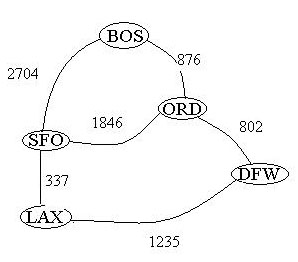
- An example of the type of graph you should be able to store is in the
diagram at right.
 Part 2--A Shortest Path Problem
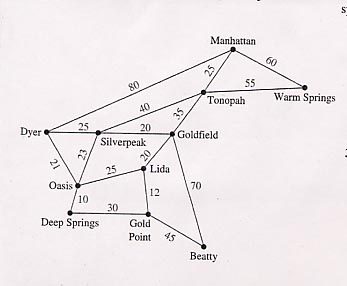
- You are to write a program that allows the user to enter the graph at right
(or another similar to it), from a file cities.txt, then finds the
shortest path from a city the user chooses
to all other cities in the graph.
- You can use any of the Java library or any code you have previously
written.
- The I/O is up to you, but should be user friendly, allowing the
user to give a file name where the data is located,
and should output the shortest path to all the cities from the given city.