A network programmer gets to use the following API :
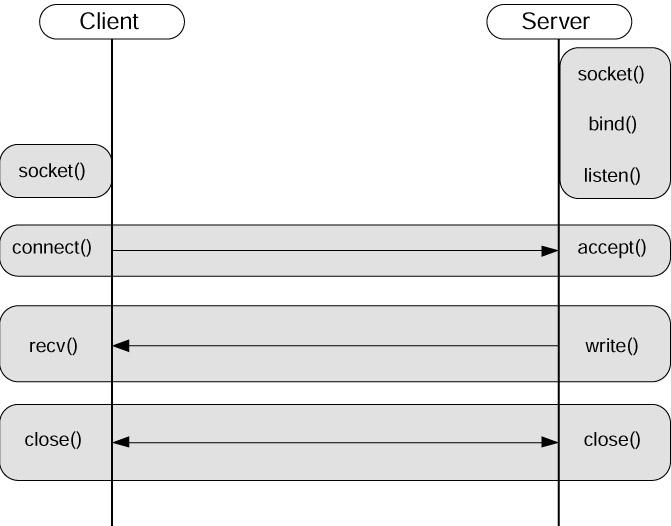
An example of client server program shows the actual usage of the API in detail. Figure 1 shows the data flow between the client and the server.
Please refer server and client code examples.
Figure 1: Client - Server Connection Flow Diagram
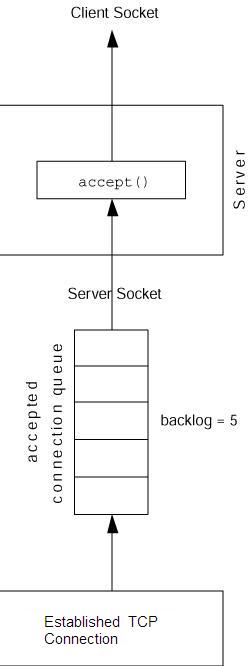
Figure 2. Server Connection Queue
Socket Options
Setting and getting options for a socket is performed through two functions, setsockopt() and getsockopt(). These functions provide a single interface for getting and setting a variety of options using a number of different structures. The socket option prototypes are given below:
| #include <sys/types.h> #include <sys/socket.h> int getsockopt( int socket, int level, int optionname, void *optval, socklen_t *optlength ); int setsockopt( int socket, int level, int optionname, void *optval, socklen_t optlength ); |
The level refers to the layer of protocol to which this option will be applied. The option name is given by optionname. Various options exist depending on the protocol of interest. The optval argument specifies the value to be set or the location to store the option in a GET request. Finally, the optlength defines the length of the structure. As there are a number of different structures that can be used to set or get options, this parameter defines the length to avoid the call from overrunning the buffer.
|
Level |
Description |
Option Prefix |
|---|---|---|
|
SOL_SOCKET |
Sockets layer |
SO_ |
|
IPPROTO_TCP |
TCP Transport layer |
TCP_ |
|
IPPROTO_IP |
IP Network layer |
IP_ |
Each option level has a number of options that can
be manipulated.
Sockets Layer Options
The Sockets layer options are those defined within the context of level SOL_SOCKET and focus on the Sockets API layer. The typical options for the Sockets layer are defined below;
|
Option Name |
Description |
Get or Set |
|---|---|---|
|
SO_BROADCAST |
Permits transmit of broadcast datagrams |
both |
|
SO_DEBUG |
Enables debug logging |
both |
|
SO_DONTROUTE |
Enables bypass of routing tables |
both |
|
SO_ERROR |
Retrieve the current socket error |
get |
|
SO_LINGER |
Enables linger on close if data present |
both |
|
SO_KEEPALIVE |
Enables TCP Keepalive probes |
both |
|
SO_RCVBUF |
Modifies the size of the socket receive buffer |
both |
|
SO_SNDBUF |
Modifies the size of the socket send buffer |
both |
|
SO_RCVLOWAT |
Sets the minimum byte count for input |
both |
|
SO_SNDLOWAT |
Sets the minimum byte count for output |
both |
|
SO_SNDTIMEO |
Sets the timeout value for output |
both |
|
SO_RCVTIMEO |
Sets the timeout value for input |
both |
|
SO_REUSEADDR |
Enables local address reuse |
both |
|
SO_TYPE |
Retrieves the socket type |
get |
IP Layer Options
These options are those defined within the context of level
IPPROTO_IP and focus on the IP layer.
|
Option Name |
Description |
Get or Set |
|---|---|---|
| IP_HDRINCL | IP header precedes data in buffer | both |
| IP_TOS | Modifies the IP Type-Of-Service header field | both |
| IP_TTL | Modifies the IP Time-To-Live header field | both |
| IP_ADD_MEMBERSHIP | Join a multicast group | set |
| IP_DROP_MEMBERSHIP | Leave a multicast group | set |
| IP_MULTICAST_IF | Modify the outgoing multicast interface | both |
| IP_MULTICAST_TTL | Modify the outgoing multicast TTL | both |
| IP_MULTICAST_LOOP | Enable/Disable loopback of outgoing datagrams | both |
Example : IP_TOS Option
The IP_TOS option permits an application to change the Type of Service (TOS) field in the IP header of a socket. The TOS field is used to specify service precedence within networks. The TOS field permits segmenting traffic using quality of service (QOS) parameters.
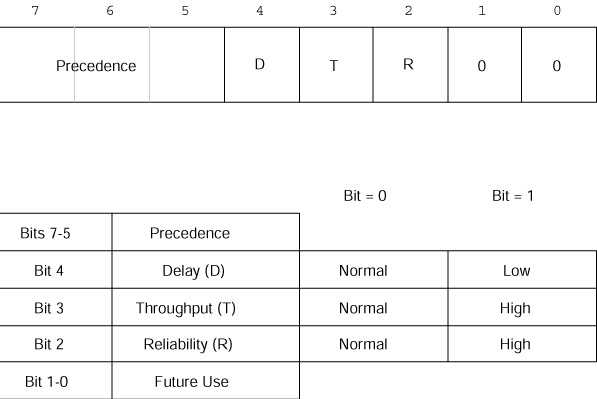
Figure: IP TOS fields
The Delay, Throughput, and Reliability bits indicate a requested
quality of service.
The IP_TOS field is used
in LAN environments to segment traffic based upon quality of
service needs. Quality of service
APIs manipulate this
field.
Accessor / Mutator Function Implementation
In the kernel code the implementation of set option function can be found in net/ipv4/ip_sockglue.c
| int ip_setsockopt(struct sock *sk, int level, int
optname, char *optval, int optlen) { int val=0,err; if (level != SOL_IP) return -ENOPROTOOPT; if (((1<<optname) & ((1<<IP_PKTINFO) | (1<<IP_RECVTTL) | (1<<IP_RECVOPTS) | (1<<IP_RECVTOS) | (1<<IP_RETOPTS) | (1<<IP_TOS) | (1<<IP_TTL) | (1<<IP_HDRINCL) | (1<<IP_MTU_DISCOVER) | (1<<IP_RECVERR) | (1<<IP_ROUTER_ALERT) | (1<<IP_FREEBIND))) || optname == IP_MULTICAST_TTL || optname == IP_MULTICAST_LOOP) { if (optlen >= sizeof(int)) { if (get_user(val, (int *) optval)) return -EFAULT; } else if (optlen >= sizeof(char)) { unsigned char ucval; if (get_user(ucval, (unsigned char *) optval)) return -EFAULT; val = (int) ucval; } } |
The get function alonmg with various option names
| int ip_getsockopt(struct sock *sk, int level, int optname, char *optval,
int *optlen) { int val; int len; if(level!=SOL_IP) return -EOPNOTSUPP; #ifdef CONFIG_IP_MROUTE if(optname>=MRT_BASE && optname <=MRT_BASE+10) { return ip_mroute_getsockopt(sk,optname,optval,optlen); } #endif if(get_user(len,optlen)) return -EFAULT; if(len < 0) return -EINVAL; lock_sock(sk); switch(optname) { case IP_OPTIONS: { unsigned char optbuf[sizeof(struct ip_options)+40]; struct ip_options * opt = (struct ip_options*)optbuf; opt->optlen = 0; if (sk->protinfo.af_inet.opt) memcpy(optbuf, sk->protinfo.af_inet.opt, sizeof(struct ip_options)+ sk->protinfo.af_inet.opt->optlen); release_sock(sk); if (opt->optlen == 0) return put_user(0, optlen); ip_options_undo(opt); len = min_t(unsigned int, len, opt->optlen); if(put_user(len, optlen)) return -EFAULT; if(copy_to_user(optval, opt->__data, len)) return -EFAULT; return 0; } case IP_PKTINFO: val = (sk->protinfo.af_inet.cmsg_flags & IP_CMSG_PKTINFO) != 0; break; case IP_RECVTTL: val = (sk->protinfo.af_inet.cmsg_flags & IP_CMSG_TTL) != 0; break; case IP_RECVTOS: val = (sk->protinfo.af_inet.cmsg_flags & IP_CMSG_TOS) != 0; break; case IP_RECVOPTS: val = (sk->protinfo.af_inet.cmsg_flags & IP_CMSG_RECVOPTS) != 0; break; case IP_RETOPTS: val = (sk->protinfo.af_inet.cmsg_flags & IP_CMSG_RETOPTS) != 0; break; case IP_TOS: val=sk->protinfo.af_inet.tos; break; case IP_TTL: val=sk->protinfo.af_inet.ttl; break; case IP_HDRINCL: val=sk->protinfo.af_inet.hdrincl; break; case IP_MTU_DISCOVER: val=sk->protinfo.af_inet.pmtudisc; break; case IP_MTU: { struct dst_entry *dst; val = 0; dst = sk_dst_get(sk); if (dst) { val = dst->pmtu; dst_release(dst); } if (!val) { release_sock(sk); return -ENOTCONN; } break; } case IP_RECVERR: val=sk->protinfo.af_inet.recverr; break; case IP_MULTICAST_TTL: val=sk->protinfo.af_inet.mc_ttl; break; case IP_MULTICAST_LOOP: val=sk->protinfo.af_inet.mc_loop; break; case IP_MULTICAST_IF: { struct in_addr addr; len = min_t(unsigned int, len, sizeof(struct in_addr)); addr.s_addr = sk->protinfo.af_inet.mc_addr; release_sock(sk); if(put_user(len, optlen)) return -EFAULT; if(copy_to_user((void *)optval, &addr, len)) return -EFAULT; return 0; } case IP_PKTOPTIONS: { struct msghdr msg; release_sock(sk); if (sk->type != SOCK_STREAM) return -ENOPROTOOPT; msg.msg_control = optval; msg.msg_controllen = len; msg.msg_flags = 0; if (sk->protinfo.af_inet.cmsg_flags&IP_CMSG_PKTINFO) { struct in_pktinfo info; info.ipi_addr.s_addr = sk->rcv_saddr; info.ipi_spec_dst.s_addr = sk->rcv_saddr; info.ipi_ifindex = sk->protinfo.af_inet.mc_index; put_cmsg(&msg, SOL_IP, IP_PKTINFO, sizeof(info), &info); } if (sk->protinfo.af_inet.cmsg_flags&IP_CMSG_TTL) { int hlim = sk->protinfo.af_inet.mc_ttl; put_cmsg(&msg, SOL_IP, IP_TTL, sizeof(hlim), &hlim); } len -= msg.msg_controllen; return put_user(len, optlen); } case IP_FREEBIND: val = sk->protinfo.af_inet.freebind; break; default: #ifdef CONFIG_NETFILTER val = nf_getsockopt(sk, PF_INET, optname, optval, &len); release_sock(sk); if (val >= 0) val = put_user(len, optlen); return val; #else release_sock(sk); return -ENOPROTOOPT; #endif } release_sock(sk); if (len < sizeof(int) && len > 0 && val>=0 && val<255) { unsigned char ucval = (unsigned char)val; len = 1; if(put_user(len, optlen)) return -EFAULT; if(copy_to_user(optval,&ucval,1)) return -EFAULT; } else { len = min_t(unsigned int, sizeof(int), len); if(put_user(len, optlen)) return -EFAULT; if(copy_to_user(optval,&val,len)) return -EFAULT; } return 0; } |